The best possible picture technologies for an incredible home theater experience
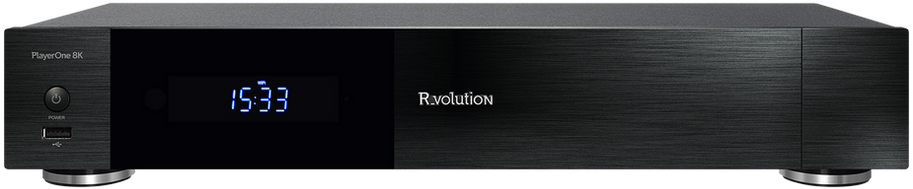
The R_volution PlayerOne 8K is a new media player compatible with Dolby Vision and HDR10+ powered by the powerful Amlogic S928X-K/J chipset !
The R_volution PlayerOne 8K is at the same time a high end media player and a media server capable of streaming content to other R_volution devices in a network through the exclusive R_share advanced streaming protocol.
The R_volution PlayerOne 8K comes with an internal hard drive bay capable of hosting up to 32 TB of movies,TV shows and concert files. It offers HDMI 2.1 output, compatibility with the latest AV1 codec up to 8K resolution in HDR and delivers stunning picture and sound quality to meet the needs of the most demanding home theater enthusiasts.
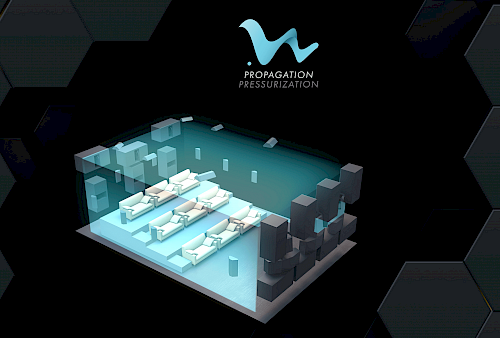
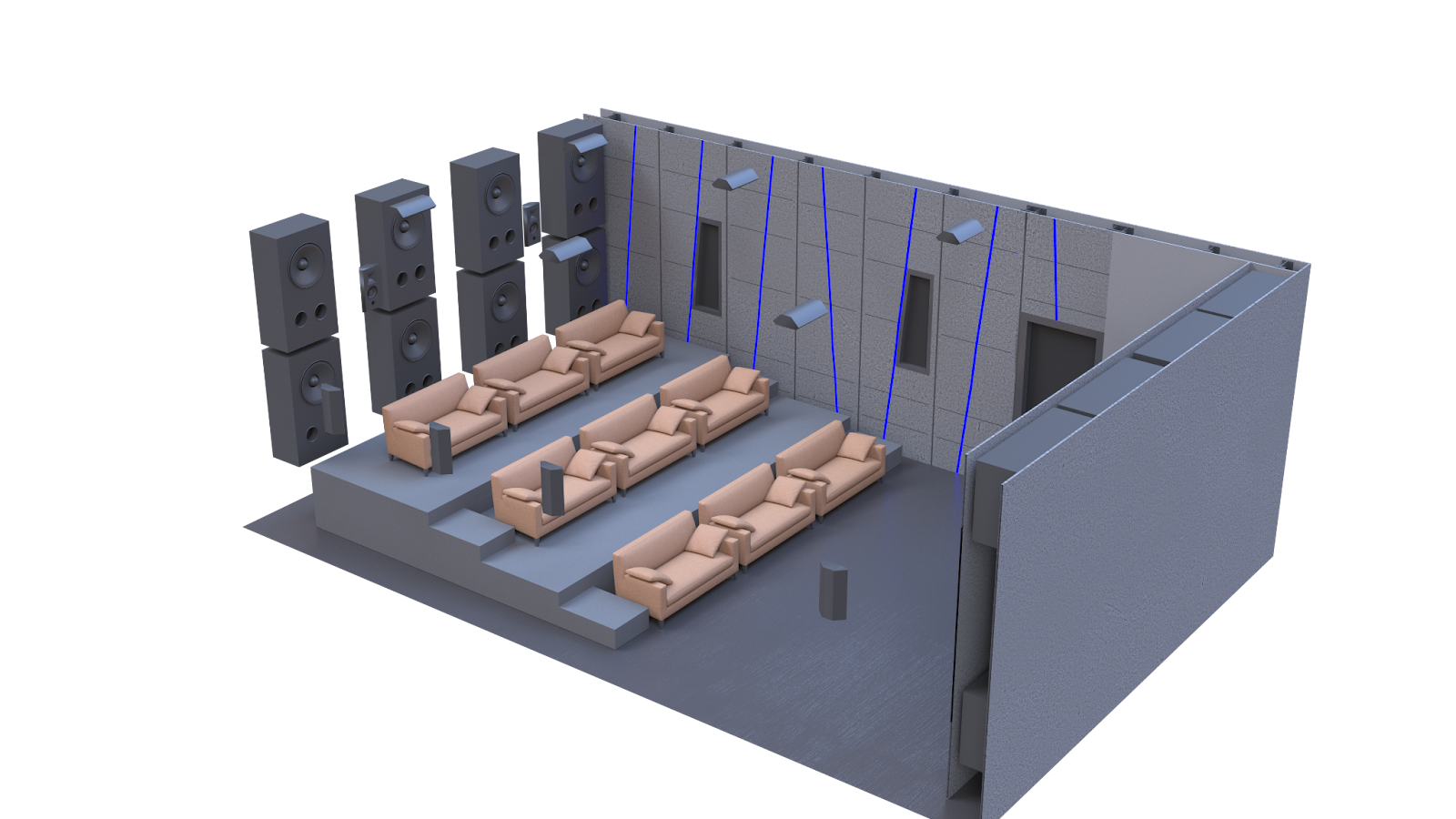
A year after the introduction of WaveForming and its unique way of controlling wave propagation. Pressurization adds to the range of active acoustic technologies from Trinnov, making available, for the first time, a dedicated technology to address each of the different acoustic behaviors in home cinema rooms.
The madVR Envy was just awarded ”2023 Best Video Processor” by Secrets of Home Theater and High Fidelity. This is the third consecutive year that a major industry publication named the Envy best video processor. This prestigious recognition highlights our consistent excellence in video processing and commitment to delivering continual innovation using cutting edge, modern day hardware.
We are absolutely thrilled, humbled, and honored to announce that our madVR Labs Envy Extreme MK2 has received an astonishing five industry awards at CEDIA 2023!
🌟 Full List of Awards: 1️⃣ CEDIA 2023 Best New Hardware Product Award 2️⃣ AVS Forum Best in Show Award 3️⃣ ProjectorCentral.com Best in Show Award 4️⃣ Sound & Vision CEDIA 2023 Editor’s Pick Award 5️⃣ AVS Forum Best in Show Award for the main demo room experience, in conjunction with our exceptional show partners Trinnov Audio, Ascendo, Kaleidescape, Barco Residential, Seymour-Screen Excellence and Officina Acustica.
A heartfelt ”Thank You” to our brilliant team, our invaluable partners, and our ever-supportive community and valued customers. Your trust and support fuel our innovation and achievements.
The CEDIA 2023 madVR Labs team proudly displaying some of our awards.
A madVR Labs jam-packed demo session in the award-winning CEDIA demo room
New from CEDIA 2023! Watch as Mark Henninger of Sound & Vision and Richard Litofsky discuss the issue of motion blur on modern displays, and how to solve this with MotionAI.
Watch as Michael Stevens and Richard Litofsky demonstrate MotionAI.
Jiles McCoy from Home Theater Fanatics interviews people at CEDIA 2023 to get their impressions of the madVR Envy Extreme MK2.
Multiple partners are revisiting their showroom systems to enable demonstration of WaveForming.
Paris, France and East Hampton, Connecticut, USA– May 31, 2023 – Trinnov Audio, designer and manufacturer of reference audio processors for home theaters, high-end hi-fi, professional audio and commercial cinemas, is pleased to announce that following the successful first public demonstration of WaveForming, its revolutionary new technology at the 2023 ISE show in Barcelona, multiple partners are incorporating the technology in their respective demonstration systems on a global basis. Trinnov’s R&D team also reports significant progress on multiple fronts.
INDUSTRY ADOPTION PROGRESS
Trinnov’s new WaveFormingTM technolgy has the promise of significantly advancing how frequency reproduction, with the potential of profoundly transforming home theater design guidelines. With the cooperation of industry partners, Trinnov’s intent is to elevate home theater performance through a design-driven approach to implementation of this scientifically uncompromised technology.
Whilst at ISE, in addition to the open demonstrations, Trinnov made exclusive presentations to key partners. As a result, over a dozen showrooms are being reconfigured to accommodate the placement of loudspeakers necessary for the technology, with dozens more interested. These projects span the globe and include showrooms of speaker manufacturers, distributors and dealers.
We are pleased to report that the response to our presentation at ISE was instant and highly positive. During the show and immediately afterward we were contacted by multiple partners indicating their interest in upgrading their showroom environments to enhance their product presentations by incorportaing Trinnov WaveFormingTM, with a number already under construction, some of which have already completed the required modifications. To our surprise, the WaveFormingTM demonstration also caught a lot of intrerest in the pro audio industry.” Arnaud Laborie, Trinnov Audio co-founder and CEO
FIRST DEMONSTRATION AFTER ISE
Krix jumped on the opportunity and has already showcased WaveFormingTM in a 5.8.4 channel configuration with an Altitude16 using the +4 channel upgrade. The screen channels are Magaphonix Flats, the surround channels are Phonix, and the height speakers are IC-52’s. They used new subwoofer designs that are currently in the prototype stage. The six seat, two row theater has a 130-inch screen and is 5.8 by 4.4. by 3.2 meters high.
We were really excited and keen to implement Trinnov’s new WaveFormingTM technology into one of our demonstration rooms, just in time for our dealer training in May. The seat-to-seat consistency and dynamic realism it brings are a huge benefit to every viewer in the audience. The results are spectacular and as a result, the response from our dealers is beyond expectation!” Michael Cox, Marketing Manager at Krix Loudspeakers.
The happy few who experienced WaveForming during a Trinnov advanced training in Australia
f you can impress professionals who calibrate and design home cinema’s for a living, then you are on to something. I know I am speaking for everyone who attended the Trinnov advanced training that what we experienced on our final day was a revelation. Watching movie scenes that we have seen 100’s of times left us with shivers and opened mouths. The tactile feel from the subwoofer array transcended our belief and understanding. Frequencies that traveled right through my body created sensations I have never felt. Not just the sheer impact, what we experienced was balanced over multiple rows of listening and subtle frequencies that only enhanced the overall cinematic soundscape. I can’t wait for the opportunity to show our clients what is possible with WaveFormingTM.” Mick Stillone, Director of Sydney HiFi Mona Vale.
AND OTHERS IMMINENT
Trinnov and Divatech solutions are already combining beautifully to deliver unparallelled sound quality. This is not only us talking, but also our best resellers. Trinnov’s demonstration at ISE was really impressive: it is a huge step forward. Our MACH systems are acoustic walls, and can inherently accommodate this new technology with minimal adjustment, making Trinnov/Divatech a match made in heaven. We can’t wait to update our processor and experience WaveFormingTM in our repurposed Showroom.” said Guillaume Dognin, CEO at Divatech.
A Divatech MACH 5 was used in Numéro Deux, a CEDIA Award winning home cinema project in 2021 by Frech integrator Dark Side of the Room. Divatech’s MACH walls consist of speaker and subwoofer (2x 10 inches woofers) modules that can easily be rearranged to accommodate the requirement of WaveFormingTM. The first demonstrations are planned in a couple of weeks at the time of writing.
Immediately after experiencing Trinnov’s demonstration at the ISE show in Barcelona, we made a commitment to integrate this technology into our European demonstration theater outside Amsterdam. We have enjoyed a long working relationship with Trinnov Audio and eagerly anticipate being able to showcase for our customers and the European market the major improvement this breakthrough technology in our reference theater environment.” Anders Uggelberg, founding partner of Procella Audio
Procella Audio’s reference theater is located at its Amsterdam offices. The theater, which was used by Procella and Trinnov at previous ISE shows, seats 15 and incorporates a 15.3.10 channel Dolby Atmos immersive audio system. The theater room is being remodeled to incorporate the newly introduced Procella P18Si single 18 inch subwoofers, which will be installed in the front and rear walls.
Last but not least, Trinnov already started preparing for CEDIA Expo where the public should expect a demonstration to be remembered.
SCIENTIFIC PROGRESS
At its first public presentation at ISE, Trinnov successfully demonstrated the dramatic improvement that WaveFormingTM can bring in an uncompromised environment. As a statement, this shows Trinnov’s ambition and determination to make available a solution with an unparalleled level of performance.
As Trinnov’s R&D progresses with more field tests, its team of engineers will compile data from each installation to enable the drafting and publication of clear installation guidelines. The guidelines are expected to become available later this summer. Whilst the recommendations for the ideal configurations are well defined, testing will provide validation for less demanding speaker layouts that will enable implementation in a wide variety of rooms and speaker layouts.
Trinnov WaveFormingTM is part of an ongoing research and development project that began over six years ago and is likely to keep the Trinnov team busy over the next decade. At this early date, along with limited public exposure, few may be able to filly appreciate its potential. In the following phase of development, the research team will pursue a more comprehensive approach, with the mission to establish how WaveFormingTM will produce the best results in any existing environment, even without requiring a physical change to the room or subwoofer/speaker layout and placement.
In May 2003, Trinnov Audio SA was incorporated near Paris, France by Arnaud Laborie, Remy Bruno and Sebastien Montoya. Fast-forward 20 years and our 3 co-founders, still at the helm today, share some insights on the beginning of this extraordinary journey and where Trinnov goes next.
A BRIEF LOOK IN THE REARVIEW MIRROR
In 20 years, Trinnov went from a student’s research project to a reference in active acoustics, and one of the most successful audio businesses in France.
20 YEARS TO BUILD A SUCCESSFUL BUSINESS
“We started in my grandmother’s living room, which we had turned into an acoustic lab covered with more than 20 custom-built speakers. Looking back, I realize how much we have done and I am very proud of what we have accomplished”, says Arnaud Laborie, co-founder and CEO.
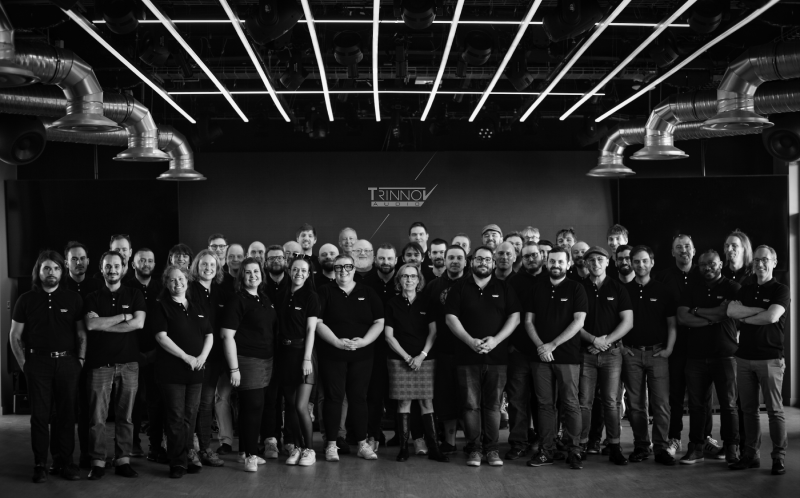
Trinnov is now a team of over 60 people spread across 6 time zones with sales representation in more than 70 countries.
Trinnov team in 2022
The company is renowned for its innovative audio processing technologies, but also develops its own hardware. Trinnov sells digital audio processors in some of the most demanding environments, ranging from professional studios (over 3000 studios use the Optimizer technology daily), commercial cinemas to high-end Hifi and home theaters.
“We have an installed base of over 10 000 processors and we are accelerating our transition from a craft operation to a true industrial operation.” added Sebastien Montoya, co-founder and head of production.
20 YEARS FIGHT FOR BETTER SOUND CALIBRATION
Besides this entrepreneurial success, Trinnov gradually managed to overcome the forceful rejection of digital acoustic correction and significantly contributed to the acceptance of such a game-changing technology, particularly in the professional audio industry.
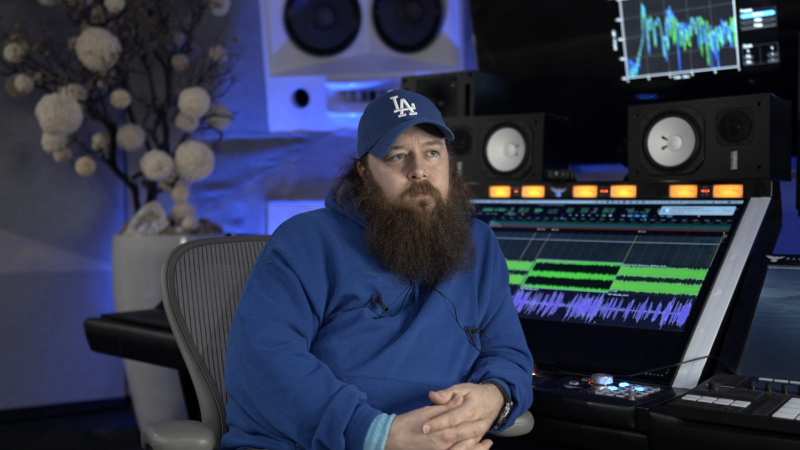
Dylan Dresdow (Prince, Beyoncé, Black Eyed Peas), interviewed in 2023
“Our first customer was the ORF, the Austrian national broadcaster and one of the most renowned audiovisual institutions in Europe, who placed an order to equip 10 of their multichannel control rooms after we personally demonstrated the benefit of our Optimizer technology. We had to wait and keep fighting hard for another 15 years before Loudspeaker/Room optimization eventually became something obvious for a majority of studio owners.” added Arnaud Laborie.
Trinnov never claimed to replace passive acoustics, but keeps challenging the benefits and limits of both active and passive acoustics and the optimal combination of both.
20 YEARS TO BUILD A REPUTATION
Trinnov’s excellent reputation might be one of the company’s most significant and valuable achievements during these first 20 years.
“I believe it essentially comes down to the fact we have always looked after our clients, and delivered stable software and hardware.” said Remy Bruno, co-founder and director of R&D.
“Hearing how positively people mention Trinnov in the industry is very rewarding but also humbling. It helps us stay focused and keeps reminding us that we have to keep working hard to maintain that reputation and to earn people’s respect”, concluded Arnaud Laborie.
THE TRINNOV FORMULA
Since its creation, Trinnov never deviated from its founding principles and original spirit. The Trinnov journey started with a true passion for audio, and was driven by innovation as well as great ambition.
INNOVATE, NOT IMITATE
“After our time at IRCAM, we had a good understanding of the state of the art in audio research. That’s why we decided to focus our own work on spatial audio, which was almost uncharted territory at the time. This was far more challenging scientifically speaking but also much more rewarding in case of success. Creating our own unique path rather than following existing trends still defines a lot of what we do.” said Arnaud Laborie.
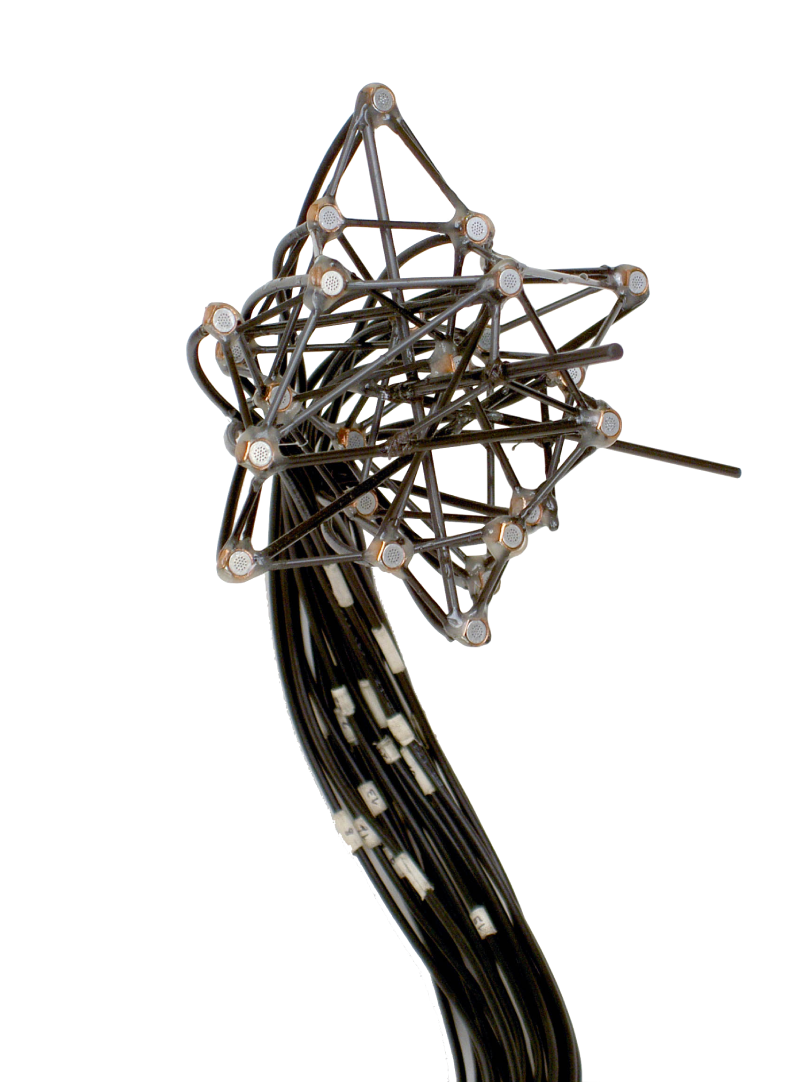
Trinnov first 24 capsule high-order ambisonic microphone
“We always had the ambition and knew we could become a world technological leader in our field of 3D audio”, added Sebastien Montoya.
“At Trinnov, we cover every step of the innovation process from fundamental research to product development. We constantly push the boundaries of knowledge about sound, acoustics, signal processing and human perception. We believe it sets us apart in our industry.” said Remy Bruno.
CREATE LASTING IMPACT, LOOK FAR AHEAD
True impactful innovation usually stands the test of time and Trinnov’s work is no exception. The Optimizer is still perceived as best-in-class, 18 years after its first introduction at the Audio Engineering Society. And our unique CPU based audio processing platform delivers unrivaled processing power. It allows the Altitude platform to remain the highest performing immersive AV Processor on the market, almost 10 years after its introduction. with the ability to render immersive sound formats at their full capability including the 34 channels Atmos channels or to process natively up to 24 channels at 192k.
The Altitude product line received more awards than any other AV Processors in history
“Quite honestly, this success is almost unintentional and just resulted from our intention to make quality products and impactful technologies, but if we consider the average life cycle, repairability, and upgradeability of our products, Trinnov is probably one of the most sustainable audio processor manufacturers”, commented Sebastien Montoya.
In fact, the notion of sustainability is truly fundamental for Trinnov. No major decision regarding technology, product, hire, or investment is made without reasonable confidence that it won’t be questioned or significantly challenged in the next 5 years.
BUILD A FANTASTIC GROUP OF INDIVIDUALS
“To make right decisions and build durable products, we rely on collective intelligence. The whole team can give their opinion and most of the time, the best decisions are consensual. This is not always the most efficient method but it enables us to avoid major mistakes. It also keeps the team engaged and motivated. This is not a management trick we have learned in a book and implemented with the help of a consultancy firm, it’s just the way it works naturally in the company”, added Remy Bruno.
“I think we have managed to create a good working environment, where people work with what they love, respect and learn from each other, never feel too much stress or under unnecessary pressure. Being fundamentally looking far ahead, with long term goals, we run a marathon, not a sprint.” added Arnaud Laborie.
EDUCATE AND SUPPORT THE INDUSTRY
True innovations open new possibilities but have also a deep impact on our habits, practices and workflows. Successful adoption takes time and requires to shift minds. This is why we are very active with education. As an example, 10 years ago when the immersive sound formats were released Trinnov had not only to resolve their compatibility but also to redefine design guidelines to ensure successful projects on the field. This work secured the adoption of high channel count immersive sound at home and has been the foundation of a significant revision of the CEDIA design guidelines (RP22) for residential integrators.
Adopting Trinnov goes well beyond acquiring a product. It is also joining a community that relies on deep expertise to elevate the industry. This is why Trinnov received the CEPro award for best training program and our CEO is still delivering some training himself, for instance at CEDIA.
STAY SAFE, STAY IN CONTROL
Trinnov raised funds twice, but is still majority owned by the 3 co-founders.
“Trinnov could grow significantly faster, but what matters more to us is to keep a healthy, organic and steady growth. So, we make sure we develop a sustainable business, diversified geographically and also by addressing very different markets. I believe this makes us more resilient than a lot of small to medium audio manufacturers”, said Sebastien Montoya.
“It is essential for us to be able to make our own decisions, to remain true to ourselves for as long as we can. We have received some offers, but Trinnov is not for sale.” said Arnaud Laborie.
This consistency, continuity, and stability helped the company grow through the 2008 and Covid-19 crisis with an average double-digit growth year to year.
2023: THE FUTURE IS ALMOST HERE
Like most other companies, the Covid-19 pandemic heavily disrupted Trinnov’s plans and required significant R&D resources to overcome the difficulties posed by the lack of certain components.
But the long-term focus prevailed.
Throughout this period, Trinnov kept hiring and significantly grew the research and development team to stay on track and even accelerate its long-term developments and critical projects.
“We look for very specific profiles, as talented as passionate about sound. It’s certainly slowed down our hiring program, but the R&D team is now almost 50% of our staff.” commented Remy Bruno.
Trinnov will continue to focus on unique breakthrough innovations that will redefine high performance sound reproduction. After pioneering – and now leading – the fields of room optimization, computer based audio, high resolution immersive sound, Trinnov is focusing on new uncharted territories that will have similar impact.
In 2023, years of extensive research and development materialized into very exciting new technologies and products, opening perspectives for what to expect next from Trinnov.
Maybe the word pivotal year applies here, to celebrate this 20th birthday with style.
WAVEFORMING
The main research project was obviously WaveForming, started more than 6 years ago, announced and showcased at ISE 2023.
WaveForming redefines low frequency reproduction with an uncompromised and revolutionary scientific approach to eliminate all sorts of wave interferences such as reflections and room modes. The second demonstration outside Trinnov and ISE was held in Australia in front of a professional audience who attended a Trinnov and Krix training.
“The feedback we got only equals the confidence we have in the potential of this new patent-pending technology”, said Arnaud Laborie.
‘‘ If you can impress professionals who calibrate and design home cinemas for a living, then you are on to something I know I am speaking for everyone who attended the Trinnov Advanced training that what we experienced on our final day was a revelation. Watching movie scenes that we have seen 100’s of times left us with shivers and opened mouths. The tactile feel from the subwoofer array transcended our belief and understanding. Frequencies that traveled right through my body created sensations I have never felt. Not just the sheer impact, what we experienced was balanced over multiple rows of listening and subtle frequencies that only enhanced the overall cinematic soundscape. Thank you to Tom, and the team at Krix for sharing their knowledge and sharing their excitement. It was contagious. I can’t wait for the opportunity to show our clients what is possible with WaveForming.” Mick Stillone, Director at Sydney HiFi Mona Vale
The whole team is really excited and proud to drive this innovation forward.
NOVA
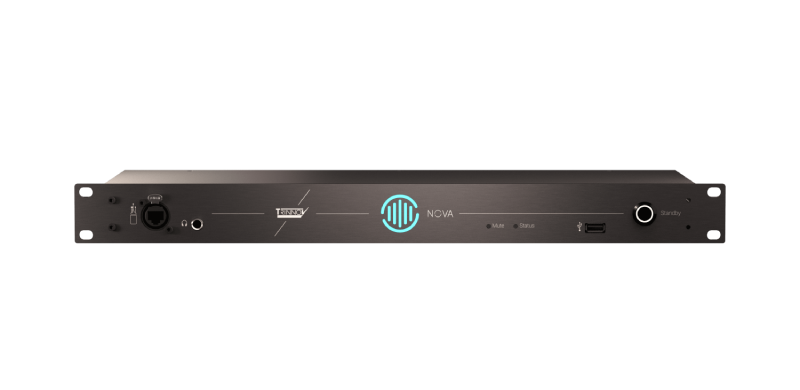
Whilst Trinnov’s research team was busy developing WaveForming, software and hardware engineers were not at rest with NOVA, the company’s latest processor introduced in April at the NAMM Show, and designed for studio application.
NOVA is not just another Trinnov processor, as it only shares the Optimizer with the rest of the range. Over the last 4 years, everything has been redesigned and rewritten:
New hardware platform
New operating system
New graphical user interface
New desktop and mobile applications
New measurement microphone
New Optimizer licenses management system
New intranet & extranet
New test benches & production lines
“NOVA changes everything for Trinnov in terms of perspective. With NOVA, we set new foundations for our next development phase, we streamline all of our internal processes and simplify the installation and operation of our products. We equip ourselves with the ability to unlock our full potential as an innovative company. We gradually make our technology more widely accessible.”, said Sebastien Montoya.
But NOVA does not change everything for Trinnov customers. For sure NOVA is more user friendly, easier to apprehend than any other Trinnov product before it. Indeed it is also the least expensive Trinnov product ever announced.
But NOVA does not change everything for Trinnov customers. For sure NOVA is more user friendly, easier to apprehend than any other Trinnov product before it. Indeed it is also the least expensive Trinnov product ever announced. But it does not fundamentally change the performance gain anyone gets from an existing Trinnov product. In fact, Trinnov believes no one could notice a difference in blind tests. Previous generations of pro products will continue to deliver state of the art room optimization for the many years to come.
WHAT’S NEXT?
As a company, in this fast changing world, Trinnov faces as many challenges as opportunities.
“As a successful, truly innovative engineering driven company, we face a lot of challenges, including the overwhelming importance of marketing and communication (our marketing team consists of only 2 full-time persons), the mindblowing flow of information, true or false, that one can read on the internet every day.” commented Arnaud Laborie.
“But as a successful, truly innovative engineering driven company, we are offered more opportunities than we can accept. Licensing, pure software solutions, the automotive or live market…the most difficult part is to carefully choose the best path, as we believe and hope we have done so far.” added Remy Bruno.
In addition to Waveforming and NOVA, we will unveil in 2023 other multi-year efforts including a massive project to open a new facility that matches the ambitions of the company.
But our 3 co-founders and the entire Trinnov team know that none of this would be possible without the incredible support from our community of suppliers, partners and customers.
“We can’t say how grateful we are to all our customers, from the early adopters who believed in our technology before anyone else, to the person who is impatiently waiting for his Trinnov processor to be delivered or installed.” said Sebastien Montoya.
“To all of you we want to say thank you. And whilst a lot of changes are happening at the moment, as disclosed in this interview, we appreciate that it may be confusing and raise questions about the future of the existing products. Rest assured of one thing: our commitment to sustainability and to our clients remains unchanged. It may take time before we can get to it, but we will keep maintaining existing products and bridge the gap to the upcoming generation of Trinnov processors to offer the same sound performance and user experience”. added Arnaud Laborie.
Meanwhile, Trinnov invites everyone to stay tuned for further announcements this year, and to seize any chance to attend upcoming WaveForming demonstrations and form an opinion out of this incredible new experience.
We are thrilled to announce that our madVR Envy Extreme MK2 has just been awarded the prestigious ProjectorCentral Editor’s Choice Award in this just-published, 5-star review! This is a testament to our dedication to providing the best possible video processing experience for our valued customers like you.
“The madVR Envy video processors provide a robust feature set that continues to grow and move this very small segment of the industry forward to keep up with today’s needs in video, while also setting madVR apart from the competition with their forward-looking outlook and approach to what today’s video processor can be and should be.”
“There’s a reason you see an Envy paired with so many brands at tradeshows. There’s a reason it has garnered so many accolades in the short time it’s been in the market. It really is a great product. When looking at the big picture of what it offers now and will offer in the future, such as MotionAI and other upcoming features being developed by madVR, it’s understandable why it receives the praise it does.”
“It has a very premium, high-end look and appeal, very attractive and much preferred over the MK1, and the included rack ears and mounting hardware are very much appreciated.”
“MotionAI really is one of the better implementations I’ve seen of motion interpolation. It even corrected the menu navigation on Apple TV and Kaleidescape, which I set in both devices to output at 23.976 Hz, resulting in menus that have a choppy look during navigation. With MotionAI, those menus looked as clean and smooth as when they are set to 60 Hz.”
“I’m glad to say that in most cases the MotionAI was right on the heels of Sony’s motion handling, or met it equally, or at times even exceeded it. The most impressive part to me was how little Soap Opera Effect there was, and therefore how well the MotionAI was able to improve clarity without losing that film-like look.”
“Instant Aspect Ratio control truly is instant […] and the transition is seamless, with each aspect ratio correctly displayed. There is no visible lag in the switch…”
“The original Envy Extreme (now designated the MK1) introduced a number of sophisticated features that have been brought along, including class leading frame-by-frame dynamic tone mapping for HDR, scaling, high-precision color calibration, and a wealth of others….”
“The Dynamic Tone Mapping that the Envy performs is some of the best I’ve seen. Regardless if the content is mastered with a maximum peak of 10,000, 4,000, or 1,000 nits, it’s displayed with a high APL while resolving detail that would normally be clipped if using a display’s own tone-mapping solution. This is also true when using the Envy for direct view displays such as an LED or OLED.”
“Those familiar or curious about Envy may have seen various videos of scenes from Harry Potter when he was fighting Voldemort alongside the ghosts of his parents in The Goblet of Fire, or shots from Aquaman when Aquaman is chained before his brother that show the detail in the window behind the throne. All of those impressive demos are legit; the Envy really does resolve all of that detail while keeping the picture bright and vibrant.”
“The Envy is capable of insanely large LUT (look-up table) calibrations allowing for interpolated 256^3 3D LUTs (16.7 million points) and 4,096-point 1D LUTs. The process is quick and produces outstanding results.”
“The Extreme MK2 is extremely quiet. I could only hear the unit if I was standing right next to it and putting my ear near it.”
“The menu system is laid out very well […] you’re not seeing a bunch of menus for stuff unrelated to what you’re trying to do. There is also a Help function on screen with a brief description of what you have highlighted.”
“If assistance is needed from a dealer, installer, or even madVR themselves they can (with the user’s permission) remote in and control the unit. Nor do you have to look much further than the new five-year parts-and-labor warranty on the Envy Extreme and Pro MK2 units to see proof of the company’s commitment to consumers and dealers. I believe that is unmatched for a product like this.”
“Fortunately, the Envy, especially with its constantly evolving feature set, will likely outlive anything in your theaterand serve you well into your next projector.”
“For all of these reasons—it’simpeccable engineering, superb build quality, future-focused features that truly enhance the viewing experience, and excellent customer support, it easily adds the ProjectorCentral Editor’s Choice award to its long list of accolades.”
See the Envy on the Samsung 146″ Micro-LED Wall with MotionAI in the Samsung Experience Center in Dallas, Texas, and get a closer look at the MK2 case design.
Rockville, MD, April 12, 2023 – madVR Labs, the industry-leading manufacturer of high-performance video processors for high-end home theaters and media rooms, is thrilled to announce the Envy MK2 Series, the next generation of their acclaimed Envy Extreme and Pro video processors. The Envy MK2 represents a significant upgrade from the previous generation and further solidifies the company’s position as a market leader today and well into the future.
The madVR Envy MK2 is a true powerhouse, with a huge boost in GPU power, upgraded system components including ECC RAM normally only found in mission critical servers, a redesigned cooling system, a new aluminum face premium backlit remote control, and an exquisite custom case. Its new Glacier X2 cooling system delivers exceptionally efficient cooling, now essentially inaudible from just a couple of feet away when running in Silent mode.
The Extreme MK2 uses the Nvidia 4080 GPU, boosting GPU power by as much as 100% and providing important headroom now and into the future, for MotionAI and other AI-based algorithms. The Envy Pro MK2 will also feature an upgraded GPU over its predecessor, with a triple-fan design for enhanced cooling efficiency and noise reduction, and share the same high-end case and premium components (aside from the GPU) as found in the Extreme MK2.
The Envy MK2 is housed in a brand new, custom engineered all-aluminum 3 mm case with a 20 mm front plate and custom matching rack ears. The engineering process involved multiple rounds of obsessive prototyping, spanning a year and a half to ensure that every aspect of the MK2 was designed and built to meet the highest standards of quality and performance. The MK2 models come with an unmatched 5-year warranty on parts and labor to give customers peace of mind and confidence in its build quality.
The company’s vision is to use adaptable modern-day hardware to deliver products that take full advantage of the latest technological advances, including Artificial Intelligence (AI), such as found in their MotionAI per-pixel motion interpolation, another industry first for the company, currently in beta.
Audio Advice founderLeon Shaw, a 47+ year A/V veteran and industry icon, switched to the Envy Extreme as his video processor of choice after first seeing the Envy Extreme MK1 in 2020. He is ecstatic about the new Envy MK2 Series and says, “The completely redesigned MK2 brings the Envy to an entirely new level, making it an even better choice for any serious home theater. Some of the technology in the Envy MK2 is not only new for them but is revolutionary for the entire industry. In all my years, I’ve never seen a company go from a start up to a luxury brand in just three short years like madVR Labs has. I’ve been very impressed how fast their team innovates and love the fact they invite our feedback. And as an added bonus, their menu system is the best I have seen on a piece of AV gear. I can’t wait to see the future updates Envy rolls out for the MK2 version as its huge amount of processing power will allow them to continue down the innovation path.”
madVR Labs Co-Founder and CEO Richard T. Litofsky says “I am incredibly proud of our team for this accomplishment and grateful to our esteemed dealers, distributors, and customers around the world for their exceptional support and feedback, which was a driving force behind the MK2 design. We believe the Envy MK2 delivers on all fronts – best-in-class video quality and performance, build quality and high reliability, and ease of use.”
The company is currently taking orders for the MK2 models. The Envy Extreme MK2 is set to start shipping in limited quantities from late April 2023. Early units will ship with the MK1 remote control, which will be replaced at no charge when the premium backlit remote control is available shortly thereafter. The Envy Pro MK2 is expected to begin shipping in summer 2023. MSRP in Europe is 21,125 EUR* and 12,790 EUR* for the Extreme MK2 and Pro MK2 respectively. Please check with your authorized Envy dealer for details or contact the company at www.madvrenvy.com.
Qualifying owners of the madVR Envy Extreme MK1 will soon have the exciting opportunity to upgrade to a brand new Extreme MK2 for just 6240 EUR* with a new 5-year warranty, by trading in their Extreme MK1 in good physical condition. The company is also introducing a program for those interested in purchasing a preowned Envy Extreme MK1 with new 2- year warranty, for an outstanding value through authorized dealers, on an as-available basis. Although the MK1 models will no longer be manufactured, the MK1 will still be supported and continue to receive firmware updates.
The Envy Extreme MK2 will make its first public showing at the TOLA Expo in Dallas, Texas, May 2-4, 2023, where it will power the video processing in the show’s main demo room, paired with the new Samsung 140” Micro LED TV. madVR Labs will also have a booth at this exciting event. Come out and meet madVR Labs’ Head of Support and Training Ryan Charpentier, Senior Sales Manager Joey Peacock, and CEO Richard Litofsky for your personal demo of the Extreme MK2.
*Pricing varies by country. Check with your local Envy dealer for pricing in your area
Paris, France – Trinnov Audio will demonstrate its new groundbreaking acoustic processing technology, based on years of research, at ISE 2023 (booth 2D150). In partnership with Krix, Sony & Officina Acustica, this new digital sound field control system makes its debut in an active 13.16.6 channel home cinema system.
The revolutionary new acoustic technology from Trinnov Audio
For the first time, Trinnov will demonstrate its new technology to the public. This innovation takes the fundamental research of Trinnov in acoustics and signal processing to the next level and effectively eliminates room modes.
“In 2023, we officially celebrate our 20th anniversary as a company. It has been an incredible journey so far and we are proud to celebrate this with style, by unveiling yet another groundbreaking technology. This is a major milestone in our development, and it will further reinforce our singularity and leadership for years to come” said Arnaud Laborie, Trinnov co-founder and CEO.
For more than 15 years, Trinnov’s Optimizer has been recognized as the best-in-class loudspeaker/room optimization technology by the most demanding experts across multiple markets, from studios to commercial cinemas and home theaters. The Optimizer’s purpose is to improve the sound reproduction of any loudspeaker in any given acoustic environment. With this major evolution and addition to the Optimizer, we rely even more dramatically on the very fundamental aspects of acoustics and physics.
In its first iteration, this new algorithm uses subwoofer arrays and sophisticated processing to control the acoustics of the room. 20 years after Trinnov’s original breakthrough research work, the French innovators return to their deepest roots and mission of innovating in acoustic field processing. With this break-through, one can truly start talking about Active Acoustics.
“We started research on this very ambitious technology more than 6 years ago. At ISE, we will be demonstrating the technology in an uncompromised environment, delivering the highest possible performance generally expected from Trinnov. Although the technology is fully functional, we will first roll it out selectively, based on specific projects, before offering the finalized software as a complimentary upgrade to Altitude16 and Altitude32 owners. We have reached a point where we believe this new technology has the potential to redefine home theater design. It may well set a new standard, and replace today’s best practices.” added Laborie.
Provided that the minimum required conditions are met, Trinnov claims this innovation can “make the room disappear”.
“Traditionally, low frequency reproduction is handled through a modal analysis where resonances are identified in the frequency domain. Through our extensive research and unique expertise in 3D acoustic fields, we propose something different. Our disruptive approach seeks to fully understand and control the behavior of the room in all its dimensions (time, frequency and the 3 dimensions of space) so that resonances are removed almost entirely and without artifacts.“
Trinnov explains that in order to achieve such results and aim for optimal performance, one must embrace a holistic approach where every aspect of the system design is understood and carefully considered.
“As our acoustician friends will all agree, you need decent room acoustics to extract the maximum benefit of a technology such as the Optimizer. Similarly, our 3D Loudspeaker Remapping technology requires sensible speaker placement to perform at its best. With this new technology, things are no different. While it will deliver remarkable improvements in most cases, the result will be truly unprecedented with a proper subwoofer implementation in the first place.”
Engineering focused demonstration
To deliver the highest possible performance, Trinnov will demonstrate this groundbreaking innovation in an uncompromised environment. Trinnov is teaming up with a few key partners, starting with long-time and trusted partner Officina Acustica.
Maurizio Conti & Peter Aylett engineered an impressive room that includes 18 seats distributed across three rows. The excellent acoustics and exquisite design Officina Acustica are known for will not disappoint, allowing maximum performance on every level and, combined with Trinnov’s new technology, across every seat.
All loudspeakers and subwoofers are provided by the Australian manufacturer Krix. The screen channels are comprised of Krix’s MX-40 LCR modules. These 3-way, bi-amped speakers feature Krix’s patented horn design, providing a uniform, constant directivity pattern, improved frequency response and extremely low distortion.
Krix’s most versatile surround speaker, the Hyperphonix 45, will be used in sixteen surround and overhead positions around the room to place viewers in the middle of the action.
The Double Bass Array consists of sixteen Cyclonix 18” subwoofers – eight at the front of the room and eight at the back. The immense output available, paired with Trinnov’s latest technology, is sure to provide a unique and visceral experience.
The whole system is driven by four Amplitude16 power amplifiers, showing its full power, capability, and versatility. Surround and overhead speakers are all powered with single-ended channels, whilst screen channels and subwoofers are all bridged.
On the video front, the system uses Sony’s flagship GTZ-380 10,000 lumen laser projector to illuminate a 5.8 meter wide screen. The VPL-GTZ380 is the world’s most advanced compact 4K Laser Projector. Designed and produced by Sony, equipped with native SXRD 4K panels, this projector can reproduce the full DCI-P3 color space without brightness loss. The 10,000 lumens delivered by “Raptor” are obtained through a dual laser light source combining blue and red lasers.
Thanks to Kordz, MadVR, Screen Research, Surgex and Zappit for completing the list of equipment used in this unique demonstration.
Arnaud Laborie to teach and join a panel dedicated to low frequency reproduction
Trinnov will continue its education effort to help integrators make the right design decisions for maximum performance. This implies a sharp understanding of the contribution and limits of each component and their optimal combination. For low frequencies, the optimal design includes individual subwoofer performance, loudspeaker layout, passive acoustics and digital acoustic optimization.
Trinnov will contribute to a CEDIA course series dedicated to low frequency reproduction. Arnaud Laborie, Trinnov CEO, will present “The Double Bass Array – Next Generation Bass” at ISE on Wednesday, February 1, at 12:30 in room CC1.4. This series also includes “Subwoofer Room Gain” by Erik Weiderholtz, Perlisten Audio CTO and “Infra Bass in Private Entertainment Spaces” by Geoffrey Heinzel, Partner at Ascendo Immersive Audio GmbH. Arnaud Laborie will also join the panel session Room Acoustics for Better Bass on Thursday, February 2, at 12:30, chaired by Peter Aylett, Partner at Officina Acustica, that will discuss the best design practices to deliver excellent bass across multiple seats.
We encourage attendees to register for this course series, where they will gain deep, research-based insight to the future of bass in home cinema.
ISE Attendees can experience Trinnov’s revolutionary technology at our booth 2D150.
Come see the madVR Envy and meet some of our team at ISE 2023. madVR Labs Co-founder and CEO Richard Litofsky, and head of Training and Support Ryan Charpentier, will be happy to greet you on the show floor in Barcelona, from Tuesday, January 31st through Friday, February 3rd.
How to Experience the Envy at ISE
The Envy will be featured in the following locations at ISE 2023:
1. Our official show booth is 2L600, where we will be exhibiting alongside our esteemed madVR Envy distributor ADEO. Meet with us for an in-depth demonstration of our latest AI-motion interpolation and see what all the hype is about!
2. The madVR Envy Extreme will be featured with our partner Trinnov Audio, and Sony, Krix and Officina Acustica in their massive, high-end demo room, featuring a 13.16.6 Atmos setup with a Krix Double Bass Array consisting of sixteen Cyclonix 18” subwoofers (yes, 16 – that’s not a typo!). The Envy will be paired with the Sony VPL-GTZ380 that is sure to blow minds, just like at CEDIA 2022. Booth location: 2D150.
3. The madVR Envy Extreme will also be featured with our partner StormAudio in the Alcons Audio demo room, paired with a Sony VPL-XW7000ES with an impressive 11.7.8 Atmos setup sure to turn heads. Booth location 7K600.
See the World’s First AI-Based Motion Interpolation
We’re excited to demonstrate the latest developments in our upcoming Motion Interpolation technology when we meet at ISE. If you are an A/V industry professional please book your meeting now for a private demo. If you are an A/V enthusiast, we would also love to meet with you – please stop by booth 2L600 at